


AHA Urges CMS Not to Finalize OPPS Proposals to Accelerate Clawback and Cut 340B Reimbursements
August 26, 2026
The Honorable Mehmet Oz, M.D.
Administrator
Centers for Medicare & Medicaid Services
7500 Security Boulevard
Baltimore, MD 21244
Re: Medicare Program: Hospital Outpatient Prospective Payment and Ambulatory Surgical Center Payment Systems (CMS-1850-P)
Dear Administrator Oz:
On behalf of our nearly 5,000 member hospitals, health systems and other healthcare organizations — including our more than 2,000 member hospitals and health systems that participate in the 340B Drug Pricing Program — as well as 270,000 affiliated physicians, 2 million nurses and other caregivers and the 43,000 healthcare leaders who belong to our professional membership groups, the American Hospital Association (AHA) appreciates the opportunity to comment on two aspects of the Centers for Medicare & Medicaid Services’ (CMS) 2027 Hospital Outpatient Prospective Payment and Ambulatory Surgical Center Payment Systems Rule. The AHA will submit separate comments on other aspects of the proposed rule. This letter addresses CMS’ proposals to (1) increase the annual reduction to the outpatient prospective payment system (OPPS) conversion factor under 42 C.F.R. § 419.32(b)(1)(iv)(B)(12) from 0.5% to 3%; and (2) pay for drugs acquired under the 340B Drug Pricing Program at average sales price (ASP) minus 33.4%. CMS should not finalize these proposals. As explained below and in prior AHA submissions, each suffers from serious legal defects and substantial policy shortcomings.
Before addressing each proposal on its own terms, it is important to consider how the two are connected. The clawback proposal traces back to a cut to 340B reimbursement rates that was proposed in 2017, first implemented in 2018, litigated through 2022, and is still the subject of regulatory proceedings in 2026. Nearly a decade after it was first proposed, CMS and hospitals are dealing with the consequences of that unlawful policy. Yet CMS now proposes another massive reduction in 340B reimbursement rates — this time resting on both an incorrect interpretation of the statute and an invalid acquisition-cost survey.
CMS should learn from that history — not repeat it. Before imposing another reimbursement cut, CMS must be certain that it has the statutory authority to act and that the benefits justify the substantial costs it will impose on 340B hospitals and the vulnerable patients they serve. At the very least, CMS must consider the time, effort and resources spent litigating and unwinding its first attempted reimbursement cut — and the prospect that, a decade from now, CMS and hospitals could find themselves doing the same thing all over again.
We respectfully submit that, on the present record, such certainty is impossible. CMS has not conducted a legally valid cost acquisition survey, and so it cannot satisfy the “important procedural prerequisite” for varying reimbursement rates by hospital group. Am. Hosp. Ass’n v. Becerra, 596 U.S. 724, 735 (2022). Nor has CMS justified its proposal to claw back more money from hospitals just as other federal policies will hit them hardest. CMS should not move forward with these proposals.
Proposal to Accelerate the Timeline of HHS’ Unlawful Clawback
The AHA opposes CMS’ proposal to accelerate the clawback of funds under 42 C.F.R. § 419.32(b)(1)(iv)(B)(12). We have explained many times why any clawback is unlawful and should never have been finalized.1 We incorporate our previous submissions and again urge the Department of Health and Human Services (HHS) to reconsider its position on this question. If CMS is going to revisit this clawback in its 2027 OPPS final rule, it should rescind § 419.32(b)(1)(iv)(B)(12) altogether because it lacks the statutory authority for any clawback on any timeline. We also have previously — and presciently — explained that allowing recoupment in these circumstances creates a serious “moral hazard” problem. Giving CMS a consequence-free do-over-via-clawback incentivizes it to take actions like the unlawful 2018-2022 reimbursement cuts that the Supreme Court invalidated — and, as explained below, the unlawful reimbursement cuts it proposes here.2
If CMS nevertheless chooses to persist with this clawback, it should not accelerate the existing timeline. Importantly, the statute does not set forth any criteria by which the agency must evaluate a clawback timeline. The fact that CMS has now proposed three different timelines in just four years illustrates that point.
Without citing any statutory benchmark, CMS has furnished its own criteria for judging the appropriate clawback timeline. But CMS has conspicuously changed its criteria over time. When CMS originally finalized its clawback in 2023, it explained that the clawback was designed to “comply with statutory budget neutrality requirements while at the same time accounting for any reliance interests and ensuring that the offset is not overly burdensome to the impacted entities.” Medicare Program; Hospital Outpatient Prospective Payment System: Remedy for the 340B-Acquired Drug Payment Policy for Calendar Years 2018-2022, 88 Fed. Reg. 77,150, 77,179 (Nov. 8, 2023) (hereinafter “Final Remedy Rule”).3 CMS now describes a different set of criteria in this proposed rule. Here, CMS emphasizes the need to “restore[] affected 340B covered entity hospitals to the financial position they would have been in had the 340B Payment Policy not been implemented in 2018.” Proposed Rule, 91 Fed. Reg. at 41,872; see id. (describing the “main premise of the Final Remedy rule” as “to implement the budget neutrality requirement in a manner that restores affected 340B covered entity hospitals to the financial position they would have been in had the 340B Payment Policy not been implemented in 2018.”). CMS also attempts to justify the proposed timeline by asserting that it “closely approximat[es] the 3.19 percent payment increase hospitals received” between CY 2018 and CY 2022. Id. Having considered only those two criteria, the proposed rule appears to no longer consider the burdens a clawback will impose on “impacted entities.” Final Remedy Rule, 88 Fed. Reg. at 77,179. That criterion has seemingly dropped out of the equation entirely. In fact, the Proposed Rule goes so far as to rewrite the history of the Final Remedy Rule, explaining that its goal was “to restore hospitals to as close to the financial position they would have been in had the 340B Payment Policy never been implemented as is reasonably feasible,” without ever acknowledging its consideration of burdens on affected hospitals. Id. at 41,871. Instead, CMS now justifies its accelerated timeline on the purported need to recoup “the funds during a timeframe that aligns with the period in which the funds were originally paid out.” Proposed Rule, 91 Fed. Reg. at 41,872.
This approach is doubly flawed. First, CMS must explain why it has changed its position on the criteria by which to evaluate a clawback timeline. Under the “change-in-position doctrine,” “agencies are free to change their existing policies as long as they provide a reasoned explanation for the change.” FDA v. Wages & White Lion Invs., LLC, 604 U.S. 542, 568 (2025) (quotation marks omitted). To satisfy this reasoned-explanation requirement, CMS “must show that there are good reasons for” its new criteria. FCC v. Fox Television Stations, Inc., 556 U.S. 502, 515 (2009). CMS therefore must explain why it no longer believes it is necessary to consider the burdens that its accelerated clawback timeline will impose on “impacted entities.” Final Remedy Rule, 88 Fed. Reg. at 77,179.
Second, even if CMS had tried, no justification can rationally support that decision. It is unreasonable to ignore the burdens of an accelerated timeline. Those burdens weigh heavily against acceleration and substantially outweigh the two factors that CMS has arbitrarily chosen to consider. Increasing the annual clawback amount from 0.5% to 3.0% will impose significant financial costs on hospitals and health systems. On average, this will be a 500% annual increase in recoupment per hospital. The actual cost could be millions of dollars each year for some hospitals.4 This is money that hospitals can no longer spend on care for patients and communities — all because the HHS pursued an unlawful policy years ago and now insists on recouping the funds faster.
Hospitals cannot afford these added financial burdens — and especially during the proposed clawback timeframe. Last year, the AHA explained how hospitals will be operating in an extraordinarily fragile economic environment during the proposed clawback timeframe.5 That environment has not meaningfully improved since last year’s proposed rule. According to Kaufman Hall’s most recent monthly report for June 2026:
Hospital bad debt and charity care grew both in dollar terms and as a percentage of gross revenue year-to-date through June, accelerating financial pressure for health systems.
. . . .
[P]erformance continues to vary across hospitals, with smaller and rural facilities bearing the greatest strain on already thin cash reserves.
Expense inflation remains a persistent drain on performance. Supply and drug expense continued rising well above inflation year-to-date through June.6
Consider hospital expenses, in particular: Kaufman Hall has reported that hospital expense growth continues to outpace inflation, with drug and labor expenses remaining significant contributors to that growth.7 Hospitals also face continuing cybersecurity threats and associated expenditures to prevent them.8 “An aging population and the increasing prevalence of chronic disease continue to raise the level of complexity and intensity of hospital care.”9 And inpatient volumes continue to increase, meaning hospitals must take care of sicker patients, while still maintaining a “fully staffed, 24/7 care environment that remains ready for anything, including disasters and large-scale emergencies.”10
Meanwhile, hospital reimbursements still do not keep up with the cost of caring. For instance, Medicare payments continue to lag behind inflation — covering just 83 cents for every dollar spent by hospitals in 2023, resulting in over $100 billion in underpayments.11 In 2023 alone, hospitals absorbed $130 billion in underpayments from Medicare and Medicaid. These shortfalls are worsening, growing on average 14% annually between 2019 and 2023. An accelerated recoupment timeline will only add to these reimbursement gaps.
The policy environment isn’t any better. Changes in a variety of federal policies — from tariffs to the expiration of the enhanced premium tax credits — will reduce hospital finances over the next several years.12 For example, this accelerated clawback timeline would impact hospitals just as they are beginning to feel the effects of the Working Families Tax Cut (Public Law 119-21).13 Although individual hospitals continue to assess exactly how the Working Families Tax Cut will affect their finances, “[a]ll providers will be affected,” and “[f]or some, the magnitude of change could threaten their ability to sustainably serve their local population.”14 Those effects are already beginning as “[m]ore and more uninsured patients are showing up in hospital emergency rooms and clinics” and, as a result, the cost of uncompensated care grows.15 According to industry benchmark data provided by Strata Decision Technology, LLC, hospital uncompensated care has risen throughout 2026, with the most recent data (as of July 31, 2026) showing a 13% increase compared to last year. And as of May 2026, “[b]ad debt and charity care per calendar day rose 16% year over year [a]nd is up 16% year to date compared with the same period in 2025. As a share of gross operating revenue, bad debt and charity care climbed 6% year over year in May and is up 8% year to date compared to 2025.”16
Don’t just take the AHA’s word for it. Independent entities have identified the financial challenges facing hospitals in the coming years. For example, Fitch Ratings recently observed that “fiscal 2025 may represent a brief operational peak—a period of relative stability afforded by the delay in OBBBA implementation—before a more challenging phase begins.… Fiscal 2027 and beyond may mark the end of the current recovery arc for many providers.”17 Similarly, healthcare advisory firm and group purchasing organization, Premier, estimates that the Working Families Tax Cut will trigger a $68 billion adverse revenue impact for hospitals in 2026 and 2027.18 “Overall, Premier data predicts that most hospitals will see a net patient revenue (NPR) reduction of between 2 and 10 percent due to [Working Families Tax Cut] implementation, with some at the extreme end of the scale set to see reductions that exceed 20 percent.”19 And McKinsey & Company recently reported:
After recovering in 2024–25, EBITDA is expected to decline by about 2 percent in 2027 compared with 2025. This drop will largely reflect the impact of ACA and Medicaid disenrollment. The disenrollment is expected to increase the uninsured population and lead to higher levels of uncompensated care along with a potential reduction in Medicaid reimbursement due to provider tax changes (not yet reflected in current estimates).20
Put simply, the proposed rule errs by failing to account for the burdens that an accelerated timeline will impose on hospitals and health systems. The costs of recent policy changes will hit hospitals just as the burdens of an accelerated clawback would begin.21 CMS cannot ignore this “important aspect of the problem.” Motor Vehicle Mfrs. Ass’n v. State Farm Mut. Auto. Ins. Co., 463 U.S. 29, 43 (1983). Even if CMS (wrongly) believes that the statute requires it to recoup funds, the statute does not tell it when or how fast to do so. CMS must explain why it must impose these additional costs on hospitals now.
The AHA strongly urges HHS to abandon this proposal. Because any clawback is illegal, it should rescind subsection 419.32(b)(1)(iv)(B)(12) altogether. But if the agency chooses to proceed with this policy, it should, at a minimum, maintain (or extend) the existing clawback timeline to account for the financial challenges that hospitals will continue to face in the coming years. In so doing, HHS must bear in mind what it wrote in the Final Remedy Rule just a few short years ago: “We take full responsibility for the legal error ultimately found by the Supreme Court.”22 In other words, HHS has acknowledged that hospitals are not to blame for this situation. Hospitals that received additional payments as a result of HHS’ illegal policy could not have declined those payments even if they wanted to. Full responsibility means recognizing that hospitals should not be punished for HHS’ mistakes — many years after HHS made those mistakes — by having to return funds that they have long since spent, at a time when their finances are already being squeezed more and more every day. These hospitals certainly should not have to do so on a faster timeline than they were originally promised, based on arbitrarily chosen criteria that in no way accounts for the burdens they will suffer under this revised clawback schedule.
Proposal to Pay for 340B Drugs Acquired Under the 340B Program by 340B Hospitals at ASP Minus 33.4%
CMS should not finalize its proposal to pay for 340B drugs acquired by certain 340B hospitals at ASP minus 33.4%. As a matter of law, the proposal does not satisfy the statute’s “important procedural prerequisite,” Am. Hosp. Ass’n, 596 U.S. at 735, because it rests on an invalid cost acquisition survey. As a matter of policy, the proposal ignores the broader regulatory context and financial environment facing hospitals in general and 340B hospitals in particular. This cut would take effect alongside other policy choices that impose substantial burdens on 340B hospitals, further straining their already-fragile finances. Nothing requires CMS to make these cuts now. It cannot and should not do so.
A. CMS Misapprehends the Statutory Standard for a Valid Survey
CMS’ proposed reimbursement cut targets a particular hospital group — 340B hospitals. To vary the reimbursement rates for outpatient prescription drugs by hospital group, CMS must conduct a valid survey of hospital acquisition costs. See 42 U.S.C. § 1395l(t)(14)(A). As the Supreme Court explained:
HHS’s authority to … vary reimbursement rates by hospital group thus depends on whether HHS has obtained acquisition cost survey data from hospitals. The statute expressly authorizes HHS to vary rates by hospital group if HHS has conducted such a survey. But the statute does not authorize such a variance in rates if HHS has not conducted a survey.
Am. Hosp. Ass’n, 596 U.S. at 735.
The statute sets forth a standard for a valid cost acquisition survey, “precisely detail[ing] the requirements for surveys of hospitals’ acquisition costs.” Id. A survey must “have a large sample of hospitals that is sufficient to generate a statistically significant estimate of the average hospital acquisition cost for each specified covered outpatient drug.” 42 U.S.C. § 1395l(t)(14)(D)(iii). CMS insists (at 41,888) that its “survey results meet this standard.” The AHA respectfully disagrees.
Based on certain statements in the proposed rule, it appears that CMS views the statutory standard for a valid survey as requiring only a sample size that is “large enough” to yield a statistically significant result.23 But the statute’s plain text imposes three distinct requirements: (1) a “large” sample of hospitals; (2) a “statistically significant estimate” of the average hospital acquisition cost (3) for “each” specified covered outpatient drug. CMS must satisfy all three.
Congress had good reason to impose multiple independent requirements for a valid survey. The survey requirement serves a critical protective function. SeeAm. Hosp. Ass’n, 596 U.S. at 735. Given the high stakes of CMS drug reimbursement decisions, the statute “protects all hospitals by imposing an important procedural prerequisite—namely, a survey of hospitals’ acquisition costs for prescription drugs—before HHS may target particular groups of hospitals for lower reimbursement rates.” Id. at 735; see Am. Hosp. Ass’n v. Azar, 967 F.3d 818, 836 (D.C. Cir. 2020) (Pillard, J., dissenting) (“I see nothing inconceivable about Congress requiring disparities in reimbursement rates to certain types of hospitals to be identified and acted upon based only on the most complete and accurate data.” (emphasis added)); id. (noting that “Congress required the agency to collect” “robust, hospital-specific data” before varying reimbursement rates by hospital group). This is, as the Supreme Court explained, a “significant aspect[]” of the statute. Am. Hosp. Ass’n, 596 U.S. at 735. Because these reimbursement decisions involve “‘billion-dollar decisions differentiating among particular hospital groups,’” it is unsurprising that Congress required CMS to satisfy all three requirements. Id. at 735 (quoting Am. Hosp. Ass’n, 967 F.3d at 837 (Pillard, J., dissenting)).
CMS seemingly agrees that a survey must satisfy the “statistical significance” factor. By contrast, CMS does not properly account for the “large”-sample-of-hospitals and “each” drug-factors. Its reading of the statute is wrong.
A “Large” Sample of Hospitals
CMS puts a “large enough” gloss on the statute’s use of the word “large.” It reads the statute to require a sample of hospitals “large enough” or “sufficiently large” to yield a statistically significant result. But under that interpretation, there was no need for Congress to use the word “large.” If all that a valid survey requires is a sample size that is “sufficiently large to produce reliable estimates of hospital outpatient drug acquisition costs for 340B drugs,” 91 Fed. Reg. 41,887, then Congress would have written just that. Under CMS’ interpretation, the word “large” does no work because the text easily could have read: “The surveys conducted under clauses (i) and (ii) shall have a large sample of hospitals that is sufficient to generate a statistically significant estimate of the average hospital acquisition cost for each specified covered outpatient drug.” That language would have accomplished exactly what CMS reads the current text to require — a sample size that is “large enough” to generate a statistically significant estimate.
But Congress did not write that statute. The statute that Congress actually wrote includes the word “large.” “The Government’s reading is thus at odds with one of the most basic interpretive canons, that a statute should be construed so that effect is given to all its provisions, so that no part will be inoperative or superfluous, void or insignificant.” Corley v. United States, 556 U.S. 303, 314 (2009). Worse than that, “the canon against surplusage is strongest when an interpretation would render superfluous another part of the same statutory scheme.” Marx v. Gen. Revenue Corp., 568 U.S. 371, 386 (2013). And the canon is strongest still when the relevant text is “part of one sentence” — “not just part of the same statutory scheme.” United States v. Fisher, 64 F.4th 329, 371 (D.C. Cir. 2023) (Katsas, J., dissenting). Here, the relevant language is, of course, part of the same statutory sentence. To give the word “large” its due meaning, it must be read as an independent requirement for a valid cost acquisition survey.
“Each” Specified Covered Outpatient Drug
The plain text of the statute requires the survey to generate a statistically significant estimate of the acquisition cost for “each” drug — not an aggregate figure for all the drugs surveyed. 42 U.S.C. § 1395l(t)(14)(D)(iii).
This use of the word “each” was not an accident. Congress used it throughout the statute. See also 42 U.S.C. § 1395l(t)(14)(D)(i)(I) (“The Comptroller General of the United States shall conduct a survey in each of 2004 and 2005 to determine the hospital acquisition cost for each specified covered outpatient drug.” (emphasis added)); see also 42 U.S.C. § 1395l(t)(14)(D)(ii) (“The Secretary, taking into account such recommendations, shall conduct periodic subsequent surveys to determine the hospital acquisition cost for each specified covered outpatient drug for use in setting the payment rates under subparagraph (A).” (emphasis added)). That word, then, must be given its ordinary meaning: “‘Each’ means ‘[e]very one of a group considered individually.’” Sierra Club v. EPA, 536 F.3d 673, 678 (D.C. Cir.2008) (quoting American Heritage Dictionary 269 (4th ed. 2001) (emphasis added)); see Dickenson Russell Coal Co. LLC v. Sec’y of Lab., 747 F.3d 251, 258(4th Cir. 2014) (“The ordinary meaning of the word ‘each’ is ‘every one of two or more people or things considered separately.’” (quoting Merriam–Webster Online Dictionary, http://www.merriam-webster.com/dictionary/each) (emphasis added)).
Congress had good reason for using “each,” as it is normally understood, in the provision setting forth the requirements for a valid survey. If the HHS Secretary is going to vary reimbursement rates by hospital group, the statute directs him to set the rate at “the average acquisition cost for the drug for that year.” 42 U.S.C. § 1395l(t)(14)(A)(iii)(I) (emphases added); see 42 U.S.C. § 1395l(t)(14)(A)(i) & (ii) (for initial post-enactment years, setting different reimbursement boundaries for different categories of drugs and not for all drugs in the aggregate). “The” drug means each drug individually — not an aggregate figure. See Niz-Chavez v. Garland, 593 U.S. 155, 167 (2021) (emphasizing a statute’s use of the word “the,” a “definite article,” to describe a “discrete thing”). In fact, the Supreme Court made exactly this point in American Hospital Association v. Becerra: “The text thus requires the reimbursement rate to be set drug by drug, not hospital by hospital or hospital group by hospital group.” (emphasis added). 596 U.S. at 733 (emphasis added). It therefore would make sense that the survey be required to provide the HHS Secretary with cost acquisition information for “each” drug so that he can then use it to set a rate for “the” drug. Because “[s]tatutory construction ... is a holistic endeavor,” United Sav. Assn. of Texas v. Timbers of Inwood Forest Assocs., Ltd., 484U.S. 365, 371 (1988), the words “each” and “the” must be interpreted together to require a drug-by-drug analysis, rather than an “aggregate” analysis, as CMS appears to read it here.
In short, 42 U.S.C. § 1395l(t)(14)(D)(iii) imposes three requirements for a valid survey: (1) a “large” sample of hospitals; (2) a “statistically significant” estimate; (3) for “each” drug. As explained below, CMS’ survey fails all of them.
B. CMS’ Survey Did Not Include a “Large” Sample of Hospitals
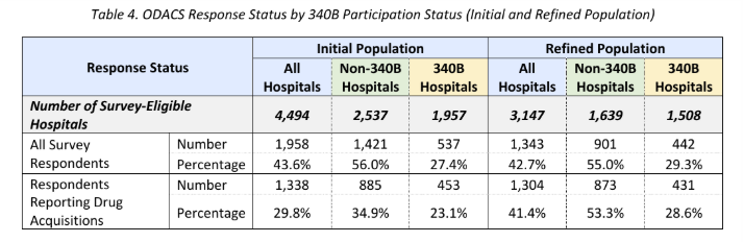
The sample of hospitals in the survey is not “large.” As Table 49 of the proposed rule indicates, CMS’ survey includes data from less than a quarter (23.1%) of 340B hospitals and less than a third (29.8%) of total hospitals. And even after a dubious “refinement” of the sample size (which increased the purported response rate by 40%), Table 50 indicates that the survey included data from only 28.6% of 340B hospitals and 41.4% of total hospitals. At best, then, CMS’ sample includes data from considerably less than half of total hospitals and less than a third of the 340B hospitals that would be subject to massive reimbursement cuts. That is not “large.” See Webster’s Third New International Dictionary 1272 (1993) (defining “large” as “[e]xceeding most other things of like kind especially in quantity or size; of considerable magnitude; big.”); Webster’s Third New International Dictionary 1474 (1993) (defining “most” as “the greatest number of; the majority of”).
The sample size is not “large” in a second important way. The statute focuses on surveying the average hospital acquisition cost for “each” drug — not an aggregate of all the drugs being surveyed. But CMS’ best-case 41.4% figure reflects the total number of hospitals that submitted data for at least one drug, even if those hospitals did not submit data for all drugs. Although CMS has wrongly withheld from public inspection drug-by-drug information for its survey, see infra at 25-26, we can be certain that some drugs had a far smaller sample than 41.4% (or 28.6%).
For example, the survey responses contain 146,117 records after imposing CMS’ initial data refinements. Because the survey covers 1,843 National Drug Codes (NDC), this suggests that the average hospital reports acquisition-cost information for only a small fraction of the drugs included in the survey. Dividing 146,117 records across the 3,686 possible NDC-by-340B-status combinations indicates an average of around 40 records per NDC. As each record corresponds to a single hospital, this means that each NDC by 340B-status combination is associated with responses from, on average, only 40 of the 3,147 hospitals included in the survey. To make matters worse, the average number of responses may overstate the amount of information available for many individual NDCs. While CMS’ methodology does not provide information on the number of records available by NDC or by NDC-340B status combination, records are unlikely to be distributed evenly across NDCs and 340B-status categories. High-volume drugs may receive substantially more reports, while less frequently purchased drugs may be supported by few observations.
We know this to be true for some of the NDCs. CMS concedes that fewer than 10 survey respondents reported data for some NDCs because the agency’s outlier-trimming methodology “necessitated removal of NDCs for which fewer than 10 survey respondents reported their purchase.”24 By definition, a drug for which fewer than 10 self-selected hospitals reported data does not include a “large” sample. A fortiori, the survey does not include a “large” sample “for each specified covered outpatient drug.”25
This point is particularly striking when considered alongside CMS’ dubious decision to “refine” the overall sample size by excluding hospitals that had no claims for the surveyed drugs.26 CMS made the decision to completely remove those hospitals from the total response rate, but it made the opposite decision to include those hospitals in its response rates even if they did not bill or acquire “each” specified covered outpatient drug. So a hospital that submitted no claims at all was removed from the refined denominator, but if that hospital submitted data for only one drug, it counts for the revised 41.4% figure. We don’t know, however, whether any particular drug has anywhere close to that overall sample size. That decision is internally inconsistent and underscores the problem with CMS’ decisions (1) to refine the overall sample size to get from 29.8% to 41.4%, (2) to ignore the statutory text requiring a “large” sample size for “each” drug, or (3) both.
If CMS proceeds with this proposal in the final rule, it must disclose the sample size of hospitals for “each” drug it surveyed. And for those drugs where a “large” number of hospitals did not submit data or would have been excluded under CMS’ dubious refinement, then the survey fails to satisfy the statutory standard. To be clear: the information already provided in Tables 49 and 50 of the proposed rule proves that the sample of hospitals was not “large” within the meaning of the statute, but the AHA suspects that this drug-by-drug information would be a further reason why the survey is legally invalid.
C. CMS’ Survey Does Not Include a “Statistically Significant Estimate” of Average Hospital Acquisition Costs
CMS agrees that its survey must yield a “statistically significant estimate of the average hospital acquisition cost” to fulfil the statutory prerequisite for varying reimbursements by hospital group. For the reasons below, it has failed to satisfy that requirement.
a. The Survey Methodology Does Not Demonstrate that the Survey Is able to Generate a Statistically Significant Estimate
The statistical validity of the OPPS Drug Acquisition Cost Survey (ODACS) estimates depends on whether the survey sample is representative of the acquisition cost for relevant drugs paid under the OPPS. CMS surveyed hospitals paid under the OPPS to gather data on acquisition costs for these drugs and applied Inverse Probability Weighting (IPW) to adjust for certain differences between the survey sample and the population of eligible hospitals that were caused by differences in response rates among different types of hospitals.
That adjustment is defective for several reasons. First, CMS focuses primarily on adjustments related to hospital-level characteristics (e.g., geographic location) and does not show that the adjustment produces a sample that is representative of drugs paid under the OPPS. Second, the underlying statistical assumptions required for IPW to be valid are unlikely to be satisfied. Given these issues, the survey estimates cannot be considered statistically significant estimates of the average hospital acquisition cost for each specified covered outpatient drug.
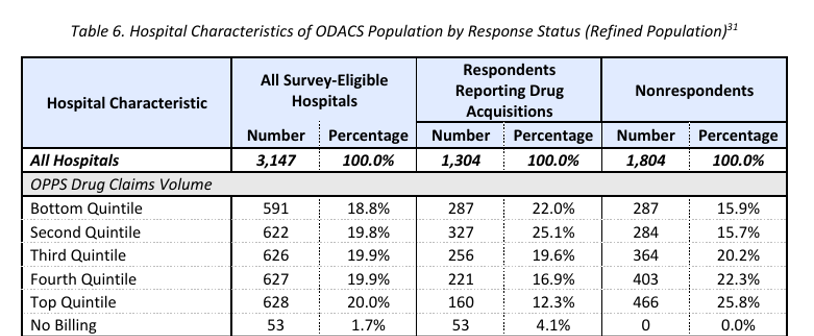
Table 6 in the Technical Report identifies several differences between characteristics of hospitals that reported drug acquisition costs in the survey (“respondents”) and hospitals that reported utilization of relevant drugs in OPPS claims but did not provide drug acquisition cost information in the survey (“nonrespondents”). To address this, CMS applies IPW to the submitted survey responses. The IPW methodology is designed to account for potential underrepresentation or overrepresentation of hospitals with particular characteristics among respondents. Although Table 10 demonstrates that IPW-adjusted respondents align more closely with the overall population distribution on select characteristics, there is a critical gap in the analysis. Despite Table 6 showing clear variation in the response rate across hospitals in different OPPS drug volume quartiles, the survey report does not disclose how the distribution of respondents on this characteristic changes after the IPW adjustment is applied. This omission makes it impossible to assess whether the weighting adequately corrected for differential response patterns across drug volume quartiles, which is an essential dimension of representativeness for a drug acquisition cost survey.
Non-response bias will distort the survey estimates if there are differences in total drug acquisition costs between responders and non-responders that are not captured by the set of basic hospital characteristics in the IPW adjustment. Any differences in per unit cost, drug mix, and acquisition volume among responders and non-responders may impact the validity of the survey estimates. For example, if the respondents tend to treat different types of patients or utilize a different mix of therapeutic classes or specific NDCs than non-respondents, the resulting estimates will not be representative unless the IPW accounts for these differences. A recent Congressional Budget Office report found that the therapeutic composition of 340B purchases differs from that of the overall drug market and attributed those differences to differences in the patient populations served by 340B providers and the specific drugs prescribed at 340B facilities.27 These differences in patient clinical mix and prescribing patterns are not captured by ODACS, and while some are observable in available data (e.g., case mix), they are not addressed by the IPW methodology.
More fundamentally, IPW can only correct for nonresponse bias when all factors impacting whether a hospital decided to respond are observable and included when building the weights. If there are any unobserved factors that are associated with the response rate and the outcome, in this case total drug acquisition costs, balancing respondents and nonrespondents on observed characteristics cannot eliminate the nonresponse bias.28
The response rate among 340B hospitals is distinctly lower than the response rate among non-340B hospitals, raising concerns that there are unobserved differences between 340B respondents and 340B non-respondents that cannot be addressed with the IPW methodology. According to Table 4, only 27.4% of 340B CMS Certification Numbers (CCNs) responded to the survey and only 23.1% reported acquiring at least one surveyed drug. After CMS’ population refinements, the response rate is 41.4% overall but only 28.6% among 340B hospitals — more than 70% of the 340B hospitals in the refined sample do not report 340B acquisition costs.
This concern is further reinforced by the response rate pattern documented in Table 6, which shows that hospitals in lower OPPS drug volume quartiles responded at higher rates than those in higher quartiles. CMS does not provide enough detail on the survey respondents in the methodology to show whether this pattern extends to 340B hospitals. If higher-volume 340B hospitals were systematically less likely to respond, or if the discounts provided to non-responding hospitals are systematically different from those provided to responding hospitals, the survey would disproportionately reflect the cost structures of a small, selected sample of 340B institutions. This introduces a bias that fatally undermines the validity of the survey and cannot be corrected through IPW, as the underlying differences in costs are driven by factors that are not fully captured by the observable characteristics used to construct the weights.
CMS also raises the possibility of coordinated non-response among 340B-participating hospitals. There is no proof for this assertion. Nor is there anything untoward if hospitals independently reached the same legal conclusion that the statute did not require them to submit survey responses and therefore the considerable costs of preparing and submitting survey responses outweighed the (non-existent) consequences for not responding. But if such coordination occurred, it would undermine the validity of the survey findings. One plausible mechanism through which such systematic differences could arise is selective participation driven by awareness of the survey’s policy implications. Given the reimbursement cuts (unlawfully) implemented from 2018 to 2022, many hospitals had reason to believe that the ODACS data were intended to inform a reimbursement policy that would reduce payment rates for 340B-applicable drugs. In this case, the difference in acquisition costs between respondents and non-respondents could reflect a self-selection-driven gap that reweighing on observed characteristics cannot adequately address.
The minimal information provided about the ODACS survey data and methodology therefore raises serious questions about potential differences in total acquisition costs between 340B hospital respondents and non-respondents. As drug acquisition costs per unit are observable only for survey respondents, the survey itself cannot show that acquisition costs do not differ systematically between these two groups. It also is unclear whether CMS could reliably adjust for all potential differences in the drug mix of nonresponding hospitals using OPPS claims data.29 CMS has not shown that the IPW adjustment used in the survey is sufficient to adjust for nonresponse bias arising from the potential differences in total acquisition costs that persist after conditioning on the observed characteristics in the weighting model.
CMS’ Technical Report on ODACS nonetheless makes two claims to support the survey’s representativeness: 1) “the consistency between unadjusted and IPW-adjusted results supports the robustness and representativeness of the acquisition cost margins derived from survey responses,” and 2) “the narrow CIs for 340B-acquired drugs support the statistical validity of the survey results on 340B drugs and indicate that the received sample is sufficiently large to produce reliable estimates of hospital outpatient drug acquisition costs for 340B drugs.”
Neither claim is grounded in sound statistical reasoning. First, consistency of the results itself does not provide meaningful information about representativeness. The similarity between the unadjusted and the IPW-adjusted results implies that adjustment using the observed characteristics has little effect on the estimated acquisition cost margins. If important determinants of nonresponse bias are unobserved or omitted from the weighting model, the unadjusted and IPW-adjusted estimates could remain consistent while still being unrepresentative of the underlying population. Second, the confidence intervals are constructed entirely on the same respondent data used in the IPW methodology, and any bias introduced by nonresponse is perpetuated into the confidence intervals. The resulting confidence intervals reflect variation among respondents, but they cannot measure how those estimates may deviate from the true population values. Thus, narrow confidence intervals can reflect greater consistency among a potentially unrepresentative group of respondents, rather than indicating that the estimate itself is reliable or representative.
Taken together, these methodological limitations mean that neither the point estimate nor the confidence intervals can be considered representative of the full 340B hospital population. The point estimates reflect only a subset of hospitals that chose to respond, and the confidence intervals do not bound the error introduced by nonresponse. It is therefore not statistically valid to apply these respondent-based estimates to the entire 340B hospital population on the assumption that the results are generalizable.
b. The Survey Does Not Establish that It Produced an Accurate Estimate of the Average Hospital Acquisition Costs
The ODACS survey data and methodology are subject to several flaws that bias acquisition cost estimates downward and overstate hospital discounts relative to ASP. Reporting inconsistencies across hospitals and incomplete data undermine the reliability of the survey results. Methodological issues in computing the ASP benchmark and in removing certain survey observations further distort margin estimates in ways that inflate the apparent discount hospitals receive.
For starters, the way hospitals were instructed to report concessions produces acquisition costs that are not uniformly comparable across respondents. According to section 2.3.2 of the Technical Report, hospitals are instructed not to include concessions that could not reasonably be attributed to a specific NDC in that NDC’s acquisition cost. Instead, additional discounts or rebates associated with participation in a group purchasing organization (GPO) or other buying group are reported separately in the price concessions field. Different hospitals may apply different internal judgments about what can “reasonably be attributed” to a specific NDC. For example, one hospital might allocate a rebate to individual NDCs based on purchase volume, while another might report the same type of rebate entirely in the price concessions field. This inconsistency leads to survey data that is not consistently measured across respondents, with a varying gap between reported and actual costs across hospitals. This discrepancy is likely to create meaningful differences in reported acquisition costs that cannot be controlled for and therefore undermine the ability to adequately analyze the results.
In addition, the completeness and accuracy of reported acquisition costs is likely to vary across drugs reported by each responding hospital. The Technical Report acknowledges that CMS observed instances where survey respondents billed a substantial number of units for a Healthcare Common Procedure Coding System (HCPCS) code without reporting that they acquired any of its corresponding NDCs in their ODACS response, indicating that the survey reporting is incomplete at the drug level. Hospitals are likely to maintain more precise cost records for high-volume drugs, where the administrative burden of tracking discounts and rebates is more easily justified. Discount amounts also tend to increase with purchase volume, meaning high-volume drugs are both more accurately reported and more likely to carry larger volume-based concessions. Lower-volume drugs, by contrast, may be reported with less precision and are less likely to attract significant discounts. As a result, the survey responses may disproportionately reflect well-documented, heavily discounted drugs. In fact, when CMS uses OPPS claim weights to rebalance using utilization by HCPCS, the resulting margin is smaller in absolute value. This change is directionally consistent with the survey-weighted results being inflated by the overrepresentation of heavily discounted drugs.30
In addition to these potential reporting errors, aggregating ASP into a single value across four quarters fails to mitigate the influence of any individual quarter with abnormal payment rates as the survey claims, and it can produce biased margin estimates. As the quarterly ASP payment rate fluctuates across quarters, CMS compares acquisition costs to both the mean and median ASP payment rate across the four quarters of the ODACS study period. However, this approach can distort margin estimates when purchase volume is not evenly distributed across quarters. A volume-weighted ASP would account for the fact that hospital purchases are not evenly distributed across quarters, assigning greater weight to the reimbursement rate in effect during periods of higher purchase activity. CMS does not employ this approach, nor offer any explanation for this methodological choice.
Lymphocyte immune globulin (Atgam) illustrates the problem. Atgam is an immunosuppressant used to prevent kidney transplant rejection and to treat severe anemia which is included in the ODACS survey.31 The corresponding ASP payment limit for this drug, under HCPCS code J7504, varied from $3,968.45 to $4,376.29 across the study period, with quarterly values of $3,982.59, $3,968.45, $4,355.73, and $4,376.29 in Q3 2024 through Q2 2025, respectively.32 This produces a mean of $4,170.77 and a median of $4,169.16. Consider a scenario in which hospital purchases were heavily concentrated in Q4 2024, with 50% of annual purchase volume occurring in that quarter and the remaining 50% distributed evenly across the three quarters. Under these hypothetical volume weights, the volume-weighted average ASP would be approximately $4,103.33, below both the simple mean and the median. Benchmarking acquisition costs against either the mean or the median in this case overstates the margin.
CMS’ data cleaning process involves the removal of survey observations on two distinct grounds, each of which raises significant concerns about the transparency and validity of the resulting acquisition cost estimates.
First, CMS excludes certain clotting factor and respiratory therapy NDCs associated with 4,398 survey records, representing 2.7% of total records received, without providing sufficient information to evaluate the need to do so or the implications of the choice. CMS asserts that records were reported in IU or MG units and displayed “substantial distortions” due to “extremely high reported unit volumes relative to total acquisition costs.” But it is unclear how CMS determined that these records were in fact reported in IU or MG units. The cost reporting template does not accommodate character inputs in the “Total Units Purchased” column, so respondents could not have explicitly labeled their entries as IU or MG, and CMS provides no explanation of the methodology or criteria it used to reach this conclusion. This lack of transparency is compounded by the absence of any discussion of whether conversion of IU or MG figures into NDC package units was considered prior to resorting to exclusion. Such a conversion is drug-specific and context-dependent, but it is not infeasible, and CMS offers no explanation of why exclusion was the only viable course of action. Furthermore, CMS provides no breakdown of how many records for each affected NDC were deemed to have been reported in incorrect units versus how many appeared otherwise valid, making it impossible to assess whether the wholesale exclusion of all observations for a given NDC was justified or whether a more targeted approach could have preserved usable data. Moreover, the decision to remove all records for certain clotting factors and respiratory therapy NDCs, rather than individual problematic records, indicates that CMS was ultimately unable to produce a reliable, drug-specific acquisition cost estimate for the affected NDCs. CMS should explain which drugs lacked sufficient data and how, if at all, those gaps are addressed in the acquisition cost margin analysis. Without these disclosures, the AHA cannot fully assess the completeness of the per-drug acquisition cost estimates and the impact of the exclusion.
Second, CMS excludes reported costs above the 340B ceiling price, but this introduces a downward bias in the estimated acquisition cost, causing the estimated discount relative to ASP to appear larger than it actually is. As noted in Section 3.3.3 of the Technical Report, 4,667 survey records, representing 2.9% of 160,430 total records, are removed on the basis that the reported per-unit acquisition costs for drugs acquired through the 340B program exceeded the maximum applicable 340B ceiling price during the survey period. CMS excludes these observations on the premise that acquisition costs cannot exceed the ceiling price. However, there are many plausible circumstances under which a hospital may pay above the ceiling price. These include drug shortages, manufacturer-provider pricing disputes, or the inclusion of other costs incurred outside of direct drug acquisition such as storage fees that together exceed the ceiling price threshold. Excluding these observations on the assumption that above-ceiling costs cannot occur is unsound. Removing the highest reported acquisition costs deflates the estimated average acquisition cost and, in turn, causes the estimated discount relative to ASP to appear larger than what hospitals actually experience in practice.
For all of these reasons, CMS’ survey has not yielded a “statistically significant estimate of the average hospital acquisition cost.” That alone is fatal to its attempt to vary reimbursement rates by hospital group. At a minimum, the agency must respond to these shortcomings in its survey. The AHA respectfully submits that CMS cannot overcome these fundamental flaws in methodology, data, and results — and therefore cannot finalize this proposed cut.
D. CMS’ Survey Does Not Contain an Estimate of the Average Hospital Acquisition Cost for “Each” Specified Covered Outpatient Drug
CMS does not even attempt to include an estimate of average acquisition cost for “each” drug. Nowhere does the proposed rule present, or even claim to have generated, a statistically significant estimate of average acquisition cost for “each” individual specified covered outpatient drug. CMS’ entire analytical approach is performed in the aggregate.33 No further analysis is needed to prove that this aggregate approach fails the third statutory criterion for a valid survey.34
E. CMS’ Survey Fails its Own “Large Enough” Test
Even if CMS disagrees with the AHA’s interpretation of the statute, it still cannot lawfully rely on its survey to vary reimbursement rates across hospital groups. CMS’ survey fails under its own “large enough” approach to the statute for two reasons.
For starters, it is common ground that a “statistically significant” estimate is a core requirement of any valid survey. As explained above, the survey did not produce a statistically significant estimate of hospital acquisition costs for each drug. That alone is fatal under any reading of the statute.
But just as important, CMS’ survey does not come close to satisfying CMS’ “large enough” gloss on the statute. If CMS truly believes that all the statute requires is a “large enough” sample size to generate a statistically significant estimate, see infra at 10 n.23, its survey still must have a “large enough” sample to “generate a statistically significant estimate of the average hospital acquisition cost for each specified covered outpatient drug.” See generally TRW Inc. v. Andrews, 534 U.S. 19, 31 (2001) (courts must “give effect, if possible, to every clause and word of a statute.”).
Several key statements in the proposed rule ignore that italicized portion of the statute, raising serious doubt about whether CMS understood this statutory obligation. For example, the proposed rule says things like: (1) “[W]e evaluated whether survey respondents comprised a large sample that is sufficient to generate statistically significant and representative estimates of hospitals’ acquisition costs,” and (2) “[T]he received sample is sufficiently large to produce reliable estimates of hospital outpatient drug acquisition costs for 340B drugs.”
Something is conspicuously missing. These statements stop at the words “acquisition cost.” They never address the statute’s additional text: “for each specified covered outpatient drug.” Thus, even taking CMS on its own terms, its statements reveal that it did not believe it necessary for an overall sample size to be “large enough” to yield a statistically significant estimate for “each” specified covered outpatient drug.
Given the results of CMS’ survey, the omission of this “each specified covered outpatient drug” language is understandable. CMS surely must know that its survey did not produce a “large enough” overall sample size to produce statistically reliable estimates for “each” drug. After all, we know that CMS excluded results for drugs that received fewer than 10 survey responses.35 By definition, then, the overall sample size was too small — i.e., not “large enough” — to conduct a survey that would yield statistically significant results for “each specified covered outpatient drug.”
Ultimately, if CMS believes that a sample must be “large enough,” then it must be “large enough” to satisfy everything the statute requires. CMS must explain why it is appropriate to read out of the statute key language — “for each specified covered outpatient drug” — or explain why its overall sample size was in fact “large enough” when the agency also excluded certain drugs that received fewer than 10 survey responses.
CMS cannot do that. Its survey was neither statistically significant nor “large enough” to generate a valid estimate for “each” specified covered outpatient drug. It therefore fails under the agency’s own gloss on the statutory standard for a valid survey.
F. Additional Problems with the Cost Acquisition Survey
CMS’ cost acquisition survey suffers from other methodological problems that the agency nowhere accounts for.
First, the proposed aggregate ASP -33.4% figure wrongly includes the effects of “penny pricing.” As flawed as it was, when the agency last conducted a cost-acquisition survey, it noted that including the effects of “penny pricing” could distort the results.36 Consequently, “in order to provide for a more conservative discount estimate, [CMS] proposed to exclude penny priced drugs from [its] analysis.”37 That was a wise decision: when the agency “excluded penny pricing, the geometric mean volume weighted average discount, using the highest NDC for a drug’s HCPCS code, decreased to 40.9 percent from 47.0 percent.”38 CMS does not explain whether (or why) it included the effects of “penny pricing” in the current survey results. Again, the agency must at a minimum justify this different decision if it chose to include “penny pricing.” If CMS continues to rely on this invalid survey, it should at least exclude “penny pricing” from any results that inform the final rule. Anything else skews the analysis and penalizes 340B hospitals for decisions made by drug companies to raise their prices faster than inflation.
Second, the survey period coincided with documented shortages of numerous surveyed drugs (e.g., Cisplatin, Carboplatin, Dacarbazine, Etoposide, hydromorphone, Dupilumab injection, Peginterferon alfa-2a, Rimabotulinumtoxinb). Yet CMS neither identified shortage-affected NDCs nor tested whether those disruptions altered hospitals’ acquisition costs or product mix. Indeed, the survey collected no information that would permit CMS to distinguish ordinary acquisition costs from costs incurred when hospitals were forced to abandon contracted products, manufacturers or purchasing channels because of a national shortage. Because CMS improperly failed to disclose survey information at the NDC level, moreover, the AHA cannot conduct this analysis itself.
Third, the data from CMS’ acquisition-cost survey also coincided with one of the most significant disruptions to the hospital supply chain in recent years. In September 2024, Hurricane Helene severely damaged Baxter’s North Cove manufacturing facility — one of the nation’s largest producers of sterile intravenous solutions and related sterile products used throughout hospital outpatient care. The resulting nationwide supply disruptions persisted for months, forcing hospitals to conserve supplies, alter purchasing practices, seek alternative manufacturers and package configurations, and prompting the Food and Drug Administration to authorize extraordinary measures, including the temporary importation of critical sterile products, to stabilize the national supply.
These were not ordinary market conditions. They were exactly the type of extraordinary supply-chain disruption that could affect hospitals’ acquisition costs and purchasing patterns for injectable drugs by forcing hospitals away from their customary suppliers, contract pricing, preferred package sizes, or preferred product configurations. Indeed, the Baxter disruption created the conditions historically known to inflate hospital drug-acquisition costs well beyond the products initially placed in shortage. Hospitals shifted medication purchasing toward premixed drugs, outsourcing facilities, alternative formulations and nontraditional suppliers.
Those are precisely the circumstances under which acquisition-cost data cease to reflect ordinary market prices. In fact, data from Vizient’s 2024 Drug Shortages Survey show that, during recent shortages involving non-saline drugs, facilities forced to purchase medications from secondary distributors reported acquisition-price increases averaging approximately 214%, with increases for some drugs reaching 600%.39 Although publicly available data do not isolate Baxter’s drug-specific price effects, there is every reason to believe those effects were real. Yet CMS nowhere considered or investigated whether this unprecedented supply chain disruption affected the acquisition-cost data on which it based its reduction in Medicare reimbursement. It must do so before finalizing any rule.
G. AHA Cannot Fully Evaluate All Aspects of the Survey Without Reviewing the Underlying Data
The survey’s many flaws are evident on the face of the proposed rule and accompanying Technical Report. The AHA does not know, however, what additional flaws may exist beneath those documents, beyond the cherry-picked information CMS has chosen to provide. To take just a few examples:
- Sample Design. The methods section provides no justification for the size of the sample selected. CMS does not explain how the chosen sample size is determined to be sufficient to generate statistically significant estimates at the individual drug level as the statute requires.
- Statistical Methodology. The report does not disclose the specific statistical formula used for IPW, nor does it identify how the variables from Table 10 are included in the IPW model. The report also fails to report the model specification, regression coefficients or standard errors. Nor does the survey disclose the distribution of estimated response probabilities or the resulting IPW weights. Without these disclosures, the IPW adjustment cannot be independently evaluated.
- Drug-Level Reporting. The report does not provide which NDCs and HCPCS codes were retained or excluded from the final analysis. It also does not identify for each NDC or HCPCS code, the number of hospitals responding, the number of observations reported for 340B and non-340B purchases, the estimated average acquisition cost, or the associated standard error or confidence interval. Additionally, while CMS acknowledges that it converts HCPCS ASP payment rates to NDC package units using adjustment factors derived from CMS crosswalks, Medi-Span, and unspecified manual review, the report does not publish the actual NDC-HCPCS crosswalk, the adjustment factors applied or the reasoning behind individual manual-review decisions.
- Penny Pricing. We do not know the impact of “penny pricing” on the aggregate survey results.
There is surely more. But the point is simple: without all the survey data, the AHA cannot fully evaluate or comment on the proposed rule. CMS therefore should release (in an anonymized fashion, if necessary) the underlying survey data and other information it relied on to reach its proposed reimbursement cut. It should then 1) delay any implementation of this proposal; and 2) permit a second comment period so the public can weigh in after having all relevant information before it.
* * * *
All in all, CMS cannot rely on the survey discussed in the proposed rule because it does not satisfy the statutory “requirements for conducting surveys of hospitals’ drug acquisition costs.” Am. Hosp. Ass’n, 596 U.S. at 728. Failure to satisfy just one criterion would have been enough, but this survey fails all three. In fact, CMS fails its own “large enough” approach to the statute because its sample size was not large enough to produce estimates for “each” drug; some had to be excluded because they received fewer than 10 survey responses. And worse yet, CMS has not disclosed the underlying survey data that would allow the AHA and other stakeholders to identify additional problems with the survey and thus to comment effectively. Regardless, because there was no valid survey here even on the cherry-picked information that was disclosed, CMS has not satisfied the “the statutory prerequisite for varying the reimbursement rates by hospital group.” Id. at 731. It therefore cannot lawfully finalize its proposed reimbursement rate cut for 340B hospitals.
H. CMS Must Consider Its Proposed Reimbursement Rate Cuts in Connection with Its Other 340B Policies
Apart from these fatal deficiencies in the cost acquisition survey, CMS should not finalize the proposed reduction in reimbursement rates because those cuts will grievously harm 340B hospitals at a precarious moment. The hospital field in general is facing serious financial headwinds. See supra at 5-8. Some of those headwinds will hit 340B hospitals the hardest because they disproportionately care for low-income patients. See Dobson DaVanzo & Assocs., LLC, 340B Hospitals Serve a Disproportionate Share of Low-Income Patients 3–4 (Sept. 2022) (finding that 340B DSH hospitals provided 77.1% of Medicaid hospital services in fiscal year 2020); see also U.S. Gov’t Accountability Off., GAO-18-521R, Drug Discount Program: Characteristics of Hospitals Participating and Not Participating in the 340B Program 19 & tbl. 12 (2018) (finding, based on CMS and HRSA data, that Medicaid revenue constituted 14.2% of revenue at the median 340B DSH hospital). Unsurprisingly, many 340B hospitals have informed the AHA that these proposed cuts — a roughly 40% reduction from current reimbursement rates — are not sustainable. If this rule is finalized, these hospitals will be forced to trim important patient services, shutter expensive service lines altogether, consider integration with more financially stable hospitals, or even close their doors.
In the midst of these general financial headwinds, moreover, both government policy and unilateral actions by the drug industry have amplified the challenges for 340B hospitals. The proposed rule ignores the cumulative effects of these policies. For example, HHS’s 340B Rebate Program will impose more than a billion dollars in unnecessary costs on 340B hospitals annually.40 CMS’ CY 2027 physician fee schedule proposed rule would make it mandatory for 340B hospitals to report claims data submissions to the forthcoming 340B claims data repository; if finalized, this new requirement also will impose significant costs and burdens on 340B entities. Meanwhile, numerous drug companies have imposed onerous and illegal claims-data submission requirements on 340B hospitals. And despite repeated AHA outreach and the fact that “the statute places the Secretary, not the manufacturers, in the driver's seat of this important program,” Novartis Pharmaceuticals Corp. v. Kennedy, No. 25-5177, 2026 WL2093937, at *6 (D.C. Cir. July 21,2026), HHS has sat on its hands for months. The agency has taken no action at all to halt the drug industry’s aggressive effort to rewrite the rules of 340B in ways that make it more expensive for hospitals to access discounts Congress requires drug companies to provide.
Yet on top of these new costs, CMS proposes a massive reduction in 340B reimbursement rates.41 These cuts are not required by law, much less required now.
CMS is choosing to propose these reimbursement cuts at the same time as it is making other burdensome changes to the 340B program and sitting on its hands as drug companies unilaterally make other expensive changes to the program.
The proposed rule does not acknowledge or address these interconnected choices. But again, CMS cannot ignore this “important aspect of the problem.” State Farm, 463U.S. at 43. CMS must address and justify the cumulative effect of its policy decisions. Once it does, it will be clear that CMS should abandon these massive reimbursement cuts because there is no sound reason to impose them in light of everything else HHS is doing — or not doing — in the 340B space right now.
I. CMS’ Proposed Reimbursement Cuts Cannot and Should Not Apply to Nonexcepted Off-Campus Departments
CMS should not finalize its proposal to extend its reimbursement cuts to drugs furnished at nonexcepted off-campus departments. The AHA has previously explained why CMS lacks the authority to impose these payment cuts under section 1833(t)(21).42 Rather than repeating those arguments at length in this letter, we incorporate them here. CMS must respond to these arguments in the final rule if it is going to finalize its proposal. See id.
The agency also lacks a sound policy rationale for this proposal. CMS appears to justify (at 41,893) applying this payment reduction to nonexcepted off-campus departments solely because not doing so could “result in significant perverse incentives for hospitals to acquire drugs, biologicals, biosimilars, and radiopharmaceuticals under the 340B program and avoid Medicare payment adjustments […].” But the agency provides no empirical evidence to prove that these supposed incentives will actually lead to the concerns it identifies. Nor does it acknowledge that there are other ways to address this purported “problem” apart from the blunt instrument of (mis-)applying the 340B reimbursement cuts to nonexcepted off-campus departments. Put differently, this proposal rests on pure speculation. That is particularly problematic because the agency estimates that this policy alone would reduce payments to 340B hospitals by approximately $920 million annually. CMS, again, nowhere considers the impact this proposal will have on hospitals, patients and communities.
Finally, the agency states (at 41,893) that these cuts would not be made budget neutral because it is “consistent with the approach to budget neutrality when we previously implemented a reduction for 340B acquired drugs furnished by nonexcepted off-campus departments.” As an initial matter, we are skeptical of CMS’ reliance on a prior practice that a unanimous Supreme Court invalidated. On the merits, CMS cannot on the one hand invoke the statute to justify applying an OPPS payment rate to nonexcepted off-campus departments that are paid under the applicable PFS system, but on the other hand state that budget neutrality requirements under 1833(t)(9)(B) do not apply to these facilities because they are paid under the applicable PFS system under 1833(t)(21). If CMS’ logic is that it has the authority to impose the OPPS payment reduction to drugs acquired under the 340B program at nonexcepted off-campus departments then it must also apply to the statute’s budget neutrality requirement. The agency cannot pick and choose when the OPPS payment system applies and when it does not. If CMS chooses to finalize its policy to pay for 340B drugs at nonexcepted off-campus departments at the reduced rate of ASP minus 33.4%, which it should not, it must at least do so in a budget neutral manner.
J. Additional Considerations if CMS Chooses to Finalize This Proposal
As explained, CMS cannot and should not finalize its proposal to reduce reimbursement rates for 340B drugs to ASP minus 33.4%. If the agency chooses to move forward, however, it should bear in mind the following three considerations.
a. CMS Should Ensure Policy is Fully Budget-Neutral on an Annual Basis
CMS proposes to budget neutralize its reimbursement cuts by increasing the OPPS conversion factor for non-drug services at all OPPS hospitals by 8.44% based on its estimate that the proposed 340B payment reduction policy will result in $4.85 billion in cuts. This proposal is consistent with the approach CMS took when it first implemented its 340B payment reduction policy in CY 2018. But for the duration of this policy between CY 2018 through CY 2022, CMS never recalculated its budget-neutrality adjustment. Instead, the agency consistently maintained a 3.19% increase to the OPPS conversion factor. In so doing, the agency did not achieve budget neutrality each year. Indeed, it failed by a wide margin. As the volume of drug claims and non-drug claims within the OPPS changed over time, the original budget-neutrality adjustment increasingly did not reflect the actual claims billed to CMS.
At the time, the AHA repeatedly urged CMS to use the OPPS claims data to recalculate the budget-neutrality adjustment to account for these volume changes. CMS did not address these concerns. Instead, the agency maintained its original adjustment, and as a result underpaid all OPPS hospitals between CYs 2018-2022, generating an approximately $2.8 billion windfall for the government. CMS acknowledged this fact when it finalized a remedy that provided lump-sum payments to 340B hospitals totaling $10.6 billion, but only sought to recoup $7.8 billion. The agency stated in the proposed rule on the remedy: “As it turns out, 340B hospitals spent more on drugs than we expected, so our policy ended up saving the Trust Fund more money from cutting the rates paid for 340B drugs than […] paid for non-drug services in our budget-neutrality adjustment to offset the savings.”
Now that the agency is proposing to impose another (unlawful) 340B payment reduction policy, we urge the agency not to make the same mistake again. If it moves forward, CMS should recalculate the budget-neutrality adjustment on an annual basis, using the actual OPPS claims data from the prior year to ensure the policy is implemented in a fully budget neutral manner.43
b. Proposed Claims Modifier Scheme is Burdensome
Since CY 2024, CMS has required all 340B hospitals to report drug claims purchased under the 340B program with a single informational “TB” modifier. Previously, the agency had adopted a different modifier scheme, requiring 340B hospitals to report either a “JG” or “TB” modifier for drugs purchased under the 340B program starting in CY 2018. Now, the agency is proposing to make yet another round of changes — now requiring all OPPS hospitals to report drug claims either under a “JG” modifier for 340B drug claims subject to the 340B payment reduction, a “TB” modifier for 340B drug claims not subject to the payment reduction, or an entirely new “XX” modifier for all non-340B drug claims.
These changes are not costless. Over the last decade, CMS has proposed and finalized several changes to its drug claims modifier requirements, each time requiring hospitals to incur significant expenses to adapt their internal billing and reporting systems. Hospitals also have incurred costs to train and re-train their pharmacy, billing and IT staff to accommodate each of CMS’ claims modifier changes. Imposing these costs is unwise and contravenes CMS’ own longstanding policy of reducing provider burden. We therefore ask the agency not to finalize this modifier proposal. Should CMS decide otherwise, it should use these claims modifiers to annually recalculate the budget-neutrality adjustment factor to ensure that the 340B payment policy is being implemented in a consistently budget-neutral manner.
c. CMS Should Include the Add-on Payment to the Proposed Payment Rate for 340B Drugs
If CMS chooses to persist with its unlawful reimbursement cut, it should, at a minimum, reconsider its proposal to exclude the add-on payment. The agency asserts that because it “took a prudent approach to estimating average acquisition costs for 340B-acquired drugs,” it “believe[s] that a conservative estimate may already account for the costs of overhead,” and therefore need not apply the add-on percentage. This is wrong. The agency provides no empirical evidence that its estimated payment rate is either conservative or already accounts for overhead costs. If CMS has such information, it must provide it and allow stakeholders to comment on it. If it does not have such information, then this proposal is, again, based on pure speculation.
Worse than that, the drug acquisition cost survey’s instructions44 made no mention of including overhead costs when asking hospitals to report net acquisition costs. CMS cannot now assert that the acquisition costs hospitals reported — and that the agency used to build its payment policy — were inclusive of overhead costs. Also, section 1833(t)(14)(E) exists precisely because Congress recognized that drug acquisition costs and overhead are distinct concepts. The statutory add-on payment is intended to account for pharmacy operations, storage, inventory management, wastage, compliance activities, handling, preparation and other drug-related costs that are incurred after the drug is acquired. CMS has previously recognized this — it has consistently applied the add-on payment when paying for separately payable drugs.
This proposal is particularly flawed because the agency is proposing to continue providing an add-on payment to hospitals exempt from its proposed payment policy, but not for hospitals subject to its proposed policy. In doing so, the agency recognizes that overhead costs are real and legitimate components of Medicare payment policy for some hospitals, but not for others. CMS provides no rationale for why the same overhead, pharmacy operations, drug handling, storage, inventory management, compliance, billing, and patient care costs disappear when the same drug is acquired by a 340B hospital subject to its proposed payment policy. Excluding any add-on payment from the proposed 340B payment rate therefore creates an arbitrary and internally inconsistent payment policy that recognizes overhead costs for some hospitals and some drugs, while ignoring those same costs for others. CMS therefore should not finalize this proposal and should instead include an add-on payment for all OPPS hospitals.
We appreciate your careful consideration of these issues. Please contact me or AHA’s director of pharmaceutical policy, Bharath Krishnamurthy, at bkrishnamurthy@aha.org, if you have any questions.
Sincerely,
/s/
Chad Golder
General Counsel & Secretary
Notes
- E.g., Letter from Ashley B. Thompson, Senior Vice President, Public Policy Analysis and Development to Mehmet Oz, Administrator, CMS re: Medicare and Medicaid Programs: Hospital Outpatient Prospective Payment and Ambulatory Surgical Center Payment Systems; Quality Reporting Programs; Overall Hospital Quality Star Ratings; and Hospital Price Transparency; Proposed Rule (Sep. 15, 2025), at https://www.aha.org/system/files/media/file/2025/09/2025-09-15-AHA-Comments-on-CMS-CY-2026-Outpatient-ASC-Proposed-Payment-Rule.pdf; Letter from Melinda Reid Hatton, General Counsel and Secretary, American Hospital Association to Chiquita Brooks-LaSure, Administrator, CMS re: Medicare Program; Hospital Outpatient Prospective Payment System: Remedy for the 340B-Acquired Drug Payment Policy for Calendar Years 2018-2022 (RIN 0938-AV18) (Aug. 7, 2023), at https://www.aha.org/lettercomment/2023-08-07-aha-letter-cmsremedy-340b-acquired-drug-payment-policy-calendar-years-2018-2022; Letter from Melinda Reid Hatton, General Counsel and Secretary, American Hospital Association to Samuel Bagenstos, General Counsel, HHS (Feb. 1, 2023), at https://www.aha.org/system/files/media/file/2023/02/aha-requestsmeeting-withhhs-to-discuss-340b-remedial-payment-outlines-principles-to-accelerate-processletter-2-1-23.pdf; Letter from Stacey Hughes, Executive Vice President, American Hospital Association to Chiquita Brooks-LaSure, Administrator, CMS, Re: CMS–1772–P (Sept. 13, 2022), at https://www.aha.org/lettercomment/2022-0913-aha-commentsopps-and-ascpayment-system-proposed-rule-cy-2023 [back^]
- Letter from Melinda Reid Hatton, General Counsel and Secretary, American Hospital Association to Chiquita Brooks-LaSure, Administrator, CMS re: Medicare Program; Hospital Outpatient Prospective Payment System: Remedy for the 340B-Acquired Drug Payment Policy for Calendar Years 2018-2022 (RIN 0938-AV18) (Aug. 7, 2023), at https://www.aha.org/lettercomment/2023-08-07-aha-letter-cmsremedy-340b-acquired-drug-payment-policy-calendar-years-2018-2022; [back^]
- See also id. at 77,170 (“Additionally, as we remarked in the proposed rule, we believed a 0.5% annual reduction in the conversion factor would be appropriate because it would balance the need to address the past payments for non-drug items and services to ensure budget neutrality while also ensuring that the offset was not immediately, in the short-term, overly financially burdensome on impacted entities, especially those in rural communities, which we believed would be the case if we were to apply an adjustment for the full offset amount in a single year.” (emphasis added); id. (“[A]s we stated previously, we believe that the proposed 0.5% annual reduction (and resulting 16-year implementation timeframe) properly reverses the increased payments for non-drug items and services to comply with statutory budget neutrality requirements while at the same time accounting for any reliance interests and ensuring that the offset is not overly burdensome on impacted entities.” (emphasis added)); id. at 77,180 (“Our methodology properly reverses the increased payments for non-drug items and services to comply with statutory budget neutrality requirements while at the same time accounting for any reliance interests and ensuring that the offset is not overly burdensome on impacted entities.” (emphasis added)); id. at 77,191 (“Such an approach would require immediate, and in many cases large, recoupments from the majority of OPPS hospitals and would impose a substantial, immediate burden on these hospitals as well as an uncertain impact on beneficiaries. Given this burden, the financial strain many hospitals experienced during the recent COVID-19 PHE, and the amount of time that has transpired since the original payments for these drugs, items, and services were made, we decided not to propose this option and overly burden these hospitals in this way, making our final option much more generous to OPPS providers.” (emphasis added). [back^]
- According to AHA analysis of Medicare OPPS claims data, on average, each hospital will need to repay over $600,000 in just CY 2027 under a 3% annual clawback. Moreover, over 500 hospitals will have repayments over $1 million in CY 2027. OPPS hospitals have an average Medicare payment to cost ratio — a measure of how much Medicare underpays a hospital relative to its costs — of approximately negative 18% according to 2024 AHA Annual Survey Data. Further, for hospitals with projected recoupments of $5 million or more, their average Medicare payment to cost ratios are approximately negative 36%. [back^]
- Letter from Ashley B. Thompson, Senior Vice President, Public Policy Analysis and Development to Mehmet Oz, Administrator, CMS re: Medicare and Medicaid Programs: Hospital Outpatient Prospective Payment and Ambulatory Surgical Center Payment Systems; Quality Reporting Programs; Overall Hospital Quality Star Ratings; and Hospital Price Transparency; Proposed Rule (Sept. 15, 2025), at https://www.aha.org/system/files/media/file/2025/09/2025-09-15-AHA-Comments-on-CMS-CY-2026-Outpatient-ASC-Proposed-Payment-Rule.pdf. [back^]
- Kaufman Hall, National Hospital Flash Report: June 2026 Data, https://www.vizient.com/insights/reports/national-hospital-flash-report/june-2026-data. [back^]
- Id.; see Kaufman Hall, April 2026 Metrics: National Hospital Flash Report, https://vizientinc-delivery.sitecorecontenthub.cloud/api/public/content/62c8f36c25124e3f9c58426302505e2d; American Hospital Association, Costs of Caring Challenges Facing America’s Hospitals as They Care for Patients in 2026 (Mar. 11, 2026), https://www.aha.org/guides-and-reports/2026-03-09-2025-cost-caring-report(“2026 Cost of Caring Report”); Laura Dydra, Hospital labor expenses escalate as C-suites rethink long-term strategy, Becker’s Hospital Review (Nov. 26, 2025),https://www.beckershospitalreview.com/workforce/hospital-labor-expenses-escalate-as-c-suite-rethink-long-term-strategy/ (“Hospital labor costs may not be spiking the way they did during the height of the staffing crisis, but recent data shows the pressure isn’t letting up.… [W]orkforce inflation has become a defining feature of the operating environment. The challenge for the C-suite isn’t reacting to sudden shocks but leading through a prolonged period of steady, structural cost escalation.”); Kaufman Hall, 2025 Health System Performance Outlook:Redefining performance in an era of financial pressure (Dec. 2025), https://www.kaufmanhall.com/sites/default/files/2025-12/KH-Report_2025%20Health-System-Performance-Outlook.pdf (“[N]on-labor expenses (8%), supply expense (8%), drugs expense (11%) and purchased services expense (9%) per calendar day increased in 2025 through September compared to the same time frame in 2024. This data aligns with what survey respondents reported — nearly 60% of whom reported non-labor cost increases of 6% to 10% over the past year.”). [back^]
- See 2026 Cost of Caring Report (“For example, hospitals spent roughly $30 billion in 2025 on the technology and services needed to protect their systems, data, and operations from cyber threats. That infrastructure is essential to keeping doors open in the community, but it adds real ongoing cost.”). [back^]
- Id. [back^]
- Id. [back^]
- Id. [back^]
- Allen, Eva H., Jennifer M. Haley, and Stephen Zuckerman. 2026. "How Will the Changing Federal Policy Landscape Affect Hospitals?" Washington, DC: Urban Institute, https://www.rwjf.org/en/insights/our-research/2026/07/how-will-the-changing-federal-policy-landscape-affect-hospitals.html (“Collectively, these policy shifts are expected to reduce enrollment in publicly subsidized coverage and increase uninsurance rates, raise hospitals’ uncompensated care costs, and elevate workforce pressures — all while constraining state resources for safety net programs. These dynamics could create considerable uncertainty and financial and operational challenges for hospitals and health systems, undermine access to care, and have broader negative effects on public health and local economies in some areas.… Most hospitals are likely to experience declines in operating margins, with one analysis estimating reductions of between 8 and 18 percentage points by 2028.”); Neha Patel and Shubham Singhal, McKinsey: What to expect in US healthcare in 2026 and beyond (Jan. 12, 2026), https://www.mckinsey.com/industries/healthcare/our-insights/what-to-expect-in-us-healthcare (“Between 2025 and 2027, hospitals will face headwinds from the impact of tariffs, subsidy expirations, and changes in federal policy, all of which are expected to reduce EBITDA margins by 40 to 100 basis points.”). [back^]
- Fitch Ratings, “OBBBA” Poses Long-Term Challenges for U.S. Not-for-Profit Hospitals (Fitch Wire, July 10, 2025, 5:01 PM ET), https://www.fitchratings.com/research/us-public-finance/obbba-poses-long-term-challenges-for-us-not-for-profit-hospitals-10-07-2025 (“As early as federal fiscal year 2026 (beginning Oct. 1, 2025), hospitals in most states will begin to feel the squeeze of increased bad debt and charity care as patients lose Medicaid and ACA marketplace plan coverage. This will pressure cash flows and degrade hospitals’ ability to serve more uninsured patients. The Act defers many of the Medicaid reforms into late 2026 and beyond, so much of the resulting margin compression will not be realized until 2027.”). [back^]
- Kaufman Hall, The more things change: Navigating the next healthcare crisis under the One Big Beautiful Bill (July 17, 2025), https://www.kaufmanhall.com/insights/article/more-things-changenavigating-next-healthcare-crisis-under-one-big-beautiful-bill; PWC, The One Big Beautiful Bill Act (OBBBA): A trillion-dollar turn in US health policy (July 10, 2025), https://www.pwc.com/us/en/industries/health-industries/library/impact-of-obbba-on-ushealth-system.html (“Hospitals, especially rural providers, will face growing financial pressure. With more uninsured patients and fewer Medicaid dollars, providers may see increases in uncompensated care, with rural hospitals being particularly vulnerable despite a $50 billion funding provision.”); id. (“Healthcare providers, especially hospitals and health systems, may experience significant pressures as federal Medicaid funding shrinks, and the number of uninsured patients grows.”). [back^]
- Reed Abelson, Uninsured Patients Rise Sharply, Hospitals Report, Citing Obamacare Cuts, N.Y. Times (July 30, 2026), https://www.nytimes.com/2026/07/30/business/aca-obamacare-health-insurance.html. [back^]
- Andrew Cass, Bad Debt, Charity Care Surge Continues to Squeeze Hospitals, Becker’s Hosp. Rev. (July 16, 2026), https://www.beckershospitalreview.com/finance/bad-debt-charity-care-surge-continues-to-squeeze-hospitals/ [back^]
- Dave Muoio, Fitch: 2025 Likely a ‘Brief Operational Peak’ for Nonprofit Hospitals Ahead of OBBBA Changes, Fierce Healthcare (Aug. 4, 2026). [back^]
- Premier, Premier Data Shows OBBBA Will Trigger a $68 Billion Hospital Revenue Impact (Dec. 15, 2025), https://premierinc.com/newsroom/blog/premier-data-shows-obbba-will-trigger-a-68-billion-hospital-revenue-impact. [back^]
- Id. [back^]
- Neha Patel and Shubham Singhal, What to expect in US healthcare in 2026 and beyond (Jan. 12, 2026), https://www.mckinsey.com/industries/healthcare/our-insights/what-to-expect-in-us-healthcare. [back^]
- These financial headwinds are especially acute for rural hospitals. Chartis reports that more than 40% of rural hospitals are operating at a loss and 417 rural facilities are vulnerable to closure. See Chartis, 2026 rural health state of the state (Feb. 10, 2026), https://www.chartis.com/insights/2026-rural-health-state-state. Chartis also found that rural hospitals have shed essential services due to financial struggles. For example, between 2011 and 2024, 331 rural hospitals stopped offering OB services. This represents approximately 27% of the nation’s rural OB units. Similarly, between 2014 and 2024, 448 rural hospitals stopped offering chemotherapy. General surgery is also decreasing in rural hospitals nationwide; Chartis reports that of the 48 states with rural hospitals, 40 have at least one rural hospital that stopped offering general surgery. As Chartis explains, “[t]he deterioration of access to these services has been a stark ‘sleeper’ metric during the closure crisis. It illustrates the difficult decisions hospital leadership teams and community-based boards of trustees must make to keep their doors open.” Id. An accelerated clawback will only worsen these problems for rural hospitals. [back^]
- 88 Fed. Reg. at 77,176. [back^]
- Proposed Rule, 91 Fed. Reg. at 41,887 (“We believe the relatively narrow confidence intervals for 340B-acquired drugs support the statistical validity of the survey results on 340B drugs and indicate that the received sample is sufficiently large to produce reliable estimates of hospital outpatient drug acquisition costs for 340B drugs.”); Id. at 41,885 (“To evaluate whether the number of survey responses was sufficient to produce statistically valid estimates of hospitals’ acquisition costs, we calculated confidence intervals for both unadjusted and IPW-adjusted acquisition cost margins. The confidence intervals provide measures of whether the survey response rate adequately captures true population-level results. When response rate is insufficiently low, confidence intervals are very wide due to the high degree of uncertainty regarding where the true result lies. Conversely, when response rate is sufficient, confidence intervals become narrower as uncertainty lessens.”); id. at 41,884 (“[W]e evaluated whether survey respondents comprised a large sample that is sufficient to generate statistically significant and representative estimates of hospitals’ acquisition costs.”). [back^]
- Ctrs. for Medicare & Medicaid Servs., OPPS Drug Acquisition Cost Survey Technical Report § 3.4 (2026). [back^]
- Nor would this number of records-per-drug be sufficient to yield a reliable survey estimate. Federal agencies have generally applied higher minimum observation thresholds as a condition of reliability for survey-based estimates. Agencies such as CMS and the Agency for Healthcare Research and Quality have historically required a minimum of 60 to 100 observations per subpopulation before an estimate is considered statistically reliable. Agency for Healthcare Research and Quality, “Precision Standards Guidelines for Reporting MEPS-HC Descriptive Statistics,” Medical Expenditure Panel Survey, May 5, 2017, https://meps.ahrq.gov/survey_comp/precision_guidelines.shtml. Against these benchmarks, a threshold of 10 records per NDC, combined with an overall average of around 40 records, suggests that a substantial number of NDC-level estimates may not be based on a sufficiently large number of observations necessary to support statistically reliable conclusions. Neither the Proposed Rule nor the ODACS Technical Report provide sufficient detail to understand the scope of this potential issue. [back^]
- Id. § 3.1.2. [back^]
- Congressional Budget Office, Growth in the 340B Drug Pricing Program (Washington, DC: Congressional Budget Office, September 2025), https://www.cbo.gov/publication/61730 [back^]
- National Academies of Sciences, Engineering, and Medicine, The Prevention and Treatment of Missing Data in Clinical Trials (Washington, DC: The National Academies Press, 2010), 56, https://doi.org/10.17226/12955; Joanna J. J. Wang, Mark Bartlett, and Louise Ryan, “On the Impact of Nonresponse in Logistic Regression: Application to the 45 and Up Study,” BMC Medical Research Methodology 17, no. 80 (2017), https://doi.org/10.1186/s12874-017-0355-z; Erin Hartman and Melody Huang, “Sensitivity Analysis for Survey Weights,” Political Analysis 32, no. 1 (2024): 1–16, https://doi.org/10.1017/pan.2023.12; Qingyuan Zhao, Dylan S. Small, and Bhaswar B. Bhattacharya, “Sensitivity Analysis for Inverse Probability Weighting Estimators via the Percentile Bootstrap,” Journal of the Royal Statistical Society: Series B (Statistical Methodology) 81, no. 4 (2019): 735–61, https://doi.org/10.1111/rssb.12327; Michael Sverchkov, “Testing Bias of Mean Estimates Due to Not Missing and Random Nonresponse With Application to the Consumer Expenditure Survey,” Statistical Survey Paper, U.S. Bureau of Labor Statistics, 2024. [back^]
- Medicare Claims Processing Manual Chapter 17 states “Hospitals should report charges for all drugs, biologicals, and radiopharmaceuticals … using the correct HCPCS codes for the items used.” But this does not necessarily provide NDC-level drug mix from non-responding hospitals. Centers for Medicare & Medicaid Services, Medicare Claims Processing Manual, Pub. 100-04, ch. 17, § 90.2, “Drugs, Biologicals, and Radiopharmaceuticals.” [back^]
- The use of weights based on HCPCS would not eliminate this concern because discounts vary by NDC. [back^]
- Centers for Medicare & Medicaid Services (CMS), “ODACS Acquisition Data Template,” Outpatient Prospective Payment System (OPPS) Drug Acquisition Cost Survey, accessed August 10, 2026, https://www.cms.gov/files/zip/odacs-acquisition-data-template.zip [back^]
- Centers for Medicare & Medicaid Services (CMS), “Medicare Part B Drug Payment Limit File,” July 2024, October 2024, January 2025, and April 2025 ASP Pricing Files, accessed August 10, 2026, https://www.cms.gov/medicare/payment/part-b-drugs/asp-pricing-files [back^]
- The exclusion of drugs with limited survey responses raises additional questions about the survey’s completeness and reliability. CMS excluded NDCs with fewer than 10 hospital respondents from the outlier analysis because reliable outlier thresholds cannot be calculated. This requirement may disproportionately affect rare-disease products, newly introduced drugs, radiopharmaceuticals, specialized oncology products, pediatric drugs, and other products concentrated among a relatively small number of hospitals or specialized treatment centers. Excluding these NDCs confirms that the survey does not generate acquisition cost estimates for each specified covered outpatient drug. The survey also does not provide estimated costs on a drug-by-drug basis and instead presents acquisition cost margins in an aggregated form comparing 340B versus non-340B drugs as a whole. This aggregation is methodologically problematic because it obscures the substantial variation in cost that exists across therapeutic categories as shown in Table 9. By collapsing these distinct categories into a single aggregate figure, the survey ignores the heterogeneity that is essential to any meaningful cost comparison. [back^]
- Notably, CMS’ decision to propose an aggregate reimbursement cut results in 340B hospitals being significantly underpaid for certain drugs, including anti-cancer therapies. This conflicts with the statute’s requirement that the amount of payment should be equal to “to the average acquisition cost for the drug for that year.” 42 U.S.C. § 1395l(t)(14)(A)(iii)(I) (emphasis added). [back^]
- Ctrs. for Medicare & Medicaid Servs., OPPS Drug Acquisition Cost Survey Technical Report § 3.4 (2026). [back^]
- Medicare Program: Hospital Outpatient Prospective Payment and Ambulatory Surgical Center Payment Systems and Quality Reporting Programs; New Categories for Hospital Outpatient Department Prior Authorization Process; Clinical Laboratory Fee Schedule: Laboratory Date of Service Policy; Overall Hospital Quality Star Rating Methodology; Physician-Owned Hospitals; Notice of Closure of Two Teaching Hospitals and Opportunity To Apply for Available Slots, Radiation Oncology Model; and Reporting Requirements for Hospitals and Critical Access Hospitals (CAHs) To Report COVID-19 Therapeutic Inventory and Usage and To Report Acute Respiratory Illness During the Public Health Emergency (PHE) for Coronavirus Disease 2019 (COVID-19), 85 Fed. Reg. 85,866, 86,047 (Dec. 29, 2020). [back^]
- Id. [back^]
- Id. [back^]
- See Vizient, Beyond the Shortage: The Hidden Cost of Drug Supply Chain Disruptions 12 (June 2025). [back^]
- See American Hospital Association, Comment Letter on Request for Information: 340B Rebate Model Pilot Program (HRSA-2026-03042) (Apr. 20, 2026), https://www.aha.org/lettercomment/2026-04-20-ahas-response-hrsa-request-information-re-potential-340b-rebate-model-pilot-program. [back^]
- The proposed rule appears to have incorrectly calculated the exact size of the cuts, but CMS has not provided enough data for anyone to know for certain. The agency has not addressed how it calculated its estimated $4.85 billion impact and the corresponding budget-neutrality adjustment of 8.44% to the OPPS conversion factor. CMS should provide stakeholders the data and methodological information necessary to independently verify the accuracy of the agency’s estimates, including which 340B providers CMS used to estimate its payment impact, whether the agency applied any exclusion criteria, and how CMS accounted for hospitals that are not included in the OPPS impact file but would be subject to the agency’s proposed 340B payment reduction policy (e.g., all-inclusive rate providers). The AHA conservatively estimates that the agency’s policy could reduce payments to these hospitals by millions of dollars annually. If these providers are not included in the OPPS impact file but are subject to the agency’s policy, the agency must justify that policy decision. [back^]
- See Letter from Thomas P. Nickels, Executive Vice President, Government Relations and Public Policy, American Hospital Association to Seema Verma, Administrator, Centers for Medicare & Medicaid Services, Re: CMS–1695–P, Proposed Changes to Hospital Outpatient Prospective Payment and Ambulatory Surgical Center Payment Systems and Quality Reporting Programs; Requests for Information on Promoting Interoperability and Electronic Health Care Information, Price Transparency, and Leveraging Authority for the Competitive Acquisition Program for Part B Drugs and Biologicals for a Potential CMS Innovation Center Model; Proposed Rule (Vol. 83, No. 147), July 31, 2018 (Sep. 24, 2018), https://www.aha.org/system/files/2018-09/180924-comment-letter-cms-outpatient-pps-asc-proposed-rule-cy2019.pdf. [back^]
- This would not be difficult for CMS to accomplish. CMS is proposing to introduce a new claims modifier scheme that will give the agency all the data it needs to determine (1) how much in OPPS payments it needs to make budget neutral and (2) whether the 8.44% adjustment to the OPPS conversion factor is sufficient. An annual analysis and adjustment also mirrors CMS’ approach to other budget-neutral policies in the OPPS such as wage index, outliers, rural SCH adjustment and the cancer hospital adjustment. [back^]
- Centers for Medicare & Medicaid Services, Medicare Outpatient Prospective Payment System (OPPS) Drug Acquisition Cost Survey (ODACS): Frequently Asked Questions (Version 2.0, Mar. 12, 2026), https://www.cms.gov/files/document/odacs-faq.pdf. [back^]
View the detailed letter.